Graduate Nursing- Advanced Practice Registered Nursing
What is Advanced Practice Registered Nursing? – Advanced Practice Registered Nursing (APRN) is defined by the four advanced practice nursing roles (Nurse Practitioner, Nurse-Midwife, Clinical Nurse Specialist, and Nurse-Anesthetist), all of which require a master’s degree at minimum and national certification in the respective role, along with state-level advanced practice licensure. They often further specialize by patient population and care setting, and in all roles serve as advanced clinicians who, in many states, have prescriptive authority and other advanced practice privileges.


As the American healthcare system works to accommodate the biggest demand it has ever faced, advanced practice registered nurses (APRNs) are increasingly being recognized as vital to ensuring the public has access to both primary and specialized services.
That fact that APRNs serve in roles identified by patient population, setting, and type of care puts them in the unique position to provide primary and preventative care services while also making advanced, highly-specialized medical care more accessible, and more affordable.
There are currently more than a quarter million APRNs practicing in the US, and thousands more entering practice each year. This contingent of highly skilled nurses represents a powerful force for change in the way healthcare is delivered.
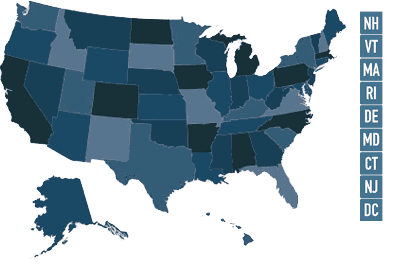
Find Info For Your State
- Alabama
- Alaska
- Arizona
- Arkansas
- California
- Colorado
- CNMI
- Connecticut
- Delaware
- District of Columbia
- Florida
- Georgia
- Guam
- Hawaii
- Idaho
- Illinois
- Indiana
- Iowa
- Kansas
- Kentucky
- Louisiana
- Maine
- Maryland
- Massachusetts
- Michigan
- Minnesota
- Mississippi
- Missouri
- Montana
- Nebraska
- Nevada
- New Hampshire
- New Jersey
- New Mexico
- New York
- North Carolina
- North Dakota
- Ohio
- Oklahoma
- Oregon
- Pennsylvania
- Rhode Island
- South Carolina
- South Dakota
- Tennessee
- Texas
- Utah
- Vermont
- Virginia
- Washington
- West Virginia
- Wisconsin
- Wyoming
A lack of access to primary care directly correlates to unnecessary emergency room visits, placing an unwarranted burden on emergency medical staff and representing an unnecessary expense to insurance providers and patients alike. A recent study conducted by the American Medical Association revealed that 70% of patients believed they would be unable to see their primary care provider the same day as needed. The study went on to reveal that as many as 40% of emergency room admissions were for issues classified as non-urgent.
By increasing access to affordable preventative care, advanced practice nurses directly contribute to eliminating gross inefficiencies in the way healthcare is administered.
APRNs in all four roles (nurse practitioners, clinical nurse specialists, nurse-midwives and nurse anesthetists) have taken on a more prominent position in the US healthcare system, widely recognized for their ability to contribute to exceptional patient outcomes while at the same time reducing healthcare costs. However, nurse practitioners hold a unique position as the largest APRN segment, earning most of the credit for increasing access to affordable primary and preventative care services.
Nurse Practitioners Have Secured a Unique Position in Today’s Healthcare System
According to the American Association of Nurse Practitioners (AANP), more than 15,000 new NPs are prepared each year through programs at 325 colleges and universities. As of January 2016, there were more than 222,000 licensed NPs in the U.S., 80 percent of whom were prepared in primary care programs.
About two-thirds of all Americans now see an NP for their primary care needs, making these advanced practice RNs the provider of choice for millions of Americans. NPs represent the clear solution to primary care physician shortages throughout the U.S. Estimates reveal that NPs treated more than 870 million patients in 2016 alone.
The AANP also reports that NPs enjoy a high level of credibility in the healthcare industry and equally high levels of patient satisfaction.
For more than 50 years, nurse practitioners (NPs) have been the driving force behind the reinvention of our nation’s delivery of primary care. Since the first nurse practitioners (NPs) graduated from the University of Colorado in 1965, the profession has grown exponentially.
Nurse practitioners, through a graduate education and extensive clinical training, diagnose and treat health conditions. Their expertise extends to disease prevention and health management, which allows them to assess patients, order and interpret diagnostic tests, make diagnoses, manage treatment plans and prescribe medications in states that grant prescriptive authority to APRNs.
Regardless of your educational background or experience, you will need to complete the following steps to become a licensed and certified nurse practitioner:
- Complete a Graduate Degree Program for Nurse Practitioners
- Earn National Certification in a Patient Population Focus
- Earn and Maintain State Licensure
Complete a Graduate Nursing Degree Program for Nurse Practitioners
The degree program you choose will depend on four primary factors:
- Accreditation
- Educational background
- Admission requirements
- Population focus and specialization
Accreditation
Master’s and doctoral degree programs for nurse practitioners are accredited by the Commission on Collegiate Nursing Education (CCNE), or the Accreditation Commission for Education in Nursing (ACEN). Most national certification boards and state licensing boards require candidates to hold a degree from an accredited program.
Educational Background
The type of degree you choose will depend on where you are in your career:
- RN-MSN: Designed for licensed RNs with an associate’s degree in nursing.
- BSN-MSN: The conventional MSN designed for RNs who have already earned their bachelor’s degree in nursing.
- Entry-Level/Direct-Entry Master’s Degrees: Designed to allow individuals with a bachelor’s degree in a field other than nursing to complete their undergraduate and graduate requirements and earn RN licensure through one, accelerated program.
- Post-Master’s Certificate Programs: Designed for master’s-prepared RNs who want to change the course of their nursing career to become an NP or NPs interested in becoming certified in an additional patient population focus or specialty.
- Doctoral Nursing Programs: Although not required to practice as an APRN, the American Association of Colleges of Nursing (AACN) recommends the Doctor of Nursing Practice (DNP) as the entry-level degree for all APRNs. As a result, the availability of DNP programs for NPs has increased significantly in recent years, with many offering multiple points of entry, including for BSNs.
Admission Requirements
Although admission requirements will vary according to the institution and your level of education and experience, you can expect these programs to be highly selective, with many requiring minimum GPAs and GRE scores.
Admissions essays, personal interviews, and letters of recommendation are also common admission requirements.
Population Focus and Specialization
The program you choose will include a focus on your NP population of choice:
- Acute care
- Adult health
- Family health
- Gerontology health
- Oncology
- Pediatric/child health
- Psychiatric/mental health
- Women’s health
You may also specialize your population focus, if desired. Remember that not all NP programs offer the choice of specialization, and among those that do, choices tend to be limited to just a few:
- Allergy/immunology
- Cardiovascular
- Dermatology
- Emergency
- Endocrinology
- Gastroenterology
- Hematology and oncology
- Neurology
- HIV/AIDS
- Occupational health
- Orthopedics
- Pulmonology and respiratory
- Sports medicine
- Urology
What to Expect
The NP core includes courses and clinical experiences related to your chosen NP population focus and specialty. Most NP programs require the completion of between 500-700 clinical hours.
Many NP grad programs are offered, at least in part, as online degrees, which allow working RNs to earn their graduate degree through a convenient, web-based format.
Online programs offer flexible schedules and interactive platforms that allow students to easily engage with faculty and peers. Many also help students find and secure clinical experiences at sites close to home.
NP programs take between 18-24 months to complete and include the following content:
Graduate Core:
- Evidence-Based Practice
- Organizational and Systems Leadership
- Healthcare Technology/Informatics
- Policy and Advocacy for Improving Population Health
APRN Core:
- Advanced physiology/pathophysiology, including general principles that apply across the lifespan
- Health assessment, including the assessment of all human systems, and advanced assessment concepts, approaches, and techniques
- Pharmacology, includes pharmacokinetics, pharmacotherapeutics, and pharmacodynamics
Earn National Certification as an NP
As you approach graduation or after completing your graduate program, you must pass a national certification exam that aligns with your NP population focus and is recognized by your state board of nursing. National certification is required for state licensure.
- American Academy of Nurse Practitioners
- Adult nurse practitioner
- Adult gerontology nurse practitioner
- Family nurse practitioner
- American Nurses Credentialing Center
- Acute care nurse practitioner
- Adult nurse practitioner
- Adult-gerontology acute care nurse practitioner
- Adult-gerontology primary care nurse practitioner
- Adult psychiatric-mental healthcare nurse practitioner
- Family primary care nurse practitioner
- Gerontological nurse practitioner
- Pediatric primary care nurse practitioner
- Psychiatric mental health nurse practitioner
- Pediatric Nursing Certification Board
- Pediatric primary care nurse practitioner
- Pediatric acute care nurse practitioner
- National Certification Corporation for the Obstetric, Gynecologic, and Neonatal Nursing Specialty
- Women’s healthcare nurse practitioner
- Neonatal nurse practitioner
- AACN Certification Corporation
- Adult-gerontology acute care nurse practitioner
Earn and Maintain State Licensure
Nurse practitioners are licensed in all U.S. states and the District of Columbia, either a. Most states also require license holders to completing specific continuing education to maintain state licensure. State licensure requires the completion of a nurse practitioner grad degree, a current and unencumbered RN license, and national certification.
Although all NPs, regardless of where they practice, are certified and licensed, inconsistency in practice privileges remains due to variations in state regulation.
This means that your role, scope of practice, and requirements regarding physician oversight and prescriptive authority will vary depending on the state in which you practice. Therefore, your state license may also require:
- A physician collaborative agreement
- Prescriptive authority application
Independent Practice and Prescriptive Authority
The NP profession has long fought for the right to practice independently and without barriers, citing a rich body of knowledge showing their work has eased physician shortages, brought healthcare to rural areas, and lowered healthcare costs for millions of Americans.
A number of national initiatives have brought much-needed attention to the value of NPs in today’s growing and increasingly complex healthcare system. For example, the Institute of Medicine’s 2011 report, The Future of Nursing: Leading Change Advancing Health, called for measures to allow APRNs to practice to the fullest extent of their education and training.
The APRN Joint Dialogue Group, through its regulation initiatives as described in the Consensus Model for APRN Regulation: Licensure, Accreditation, Certification, and Education, seeks to even the playing field for NPs and other APRNs by urging a uniform set of APRN practice laws and regulation.
Specifically, it recommends that all states align their practice privileges to allow NPs full practice rights. This effort has long been supported by such esteemed organizations as the Institute of Medicine and the National Council of State Boards of Nursing.
Physician Collaborative Agreement
If you live in a state that does not grant NPs full practice authority, you may be required to enter into a physician collaborative agreement.
Full practice rights grants NPs the authority to evaluate patients, diagnose, order and interpret diagnostic tests, and initiate and manage treatments, which includes prescribing medications without physician oversight. Many states already grant NPs and other APRNs the authority to practice independently, including Washington State, Colorado, Maine, and Washington D.C.
NPs in many states still have restricted or reduced practice authority. For example, NPs in states like Texas, California, and Florida are the most restricted, as they are required to practice under physician supervision or delegation. Other states, including Pennsylvania, Ohio, and New York, allow NPs greater practice authority, although they still require these APRNs to practice under a physician collaborative agreement.
The American Association of Nurse Practitioners (AANP) maintains a state regulatory map that shows practice rights for NPs, by state.
Prescriptive Authority
The AANP advocates for unrestricted prescriptive authority for NPs, stating that prescribing medications, treatments, devices, and modalities is a “central component of the NP role and essential to practitioner practice.”
States with full practice authority allow NPs to prescribe without oversight. States with reduced or restricted practice authority require physician oversight to prescribe medications.
Depending on the state in which you reside, you may need to apply for prescriptive authority separately from your state license. (This often comes with an additional fee.) NPs with prescriptive authority must also complete continuing education in pharmacology. You can read more about prescriptive authority requirements, by state, here.
If your NP state license allows you to prescribe controlled substances, you must also apply for DEA registration in the state in which you practice. The cost of registration is $551 and is valid for 3 years.